Showing posts with label of. Show all posts
Showing posts with label of. Show all posts
Sunday, February 9, 2014
Power Supply with principle of UPS

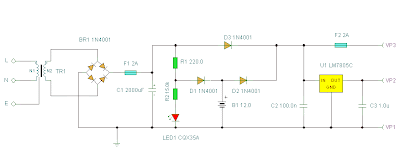
For UPS Power Supply circuit consists of lowering the voltage, rectifier, charger, batery and regulators. The technique is applied from UPS on the power supply is the use of batery and charger is connected dengang direct coupling with a series diode. For more details can be seen with the following image.
 |
| Schematics |
The rectifier in the circuit UPS Power Supply For this to function also as a charger via D1. D3 function is to drain-source voltage of the rectifier to the regulator circuit, when the AC voltage source. D2 serves to drain the batery when the source voltage from AC voltage source does not exist. batery configuration and diode D1, D2 and D3 is adopted from the UPS system. may be useful and can provide inspiration on teman2 all in making backups on the system power supply voltage.

Friday, December 27, 2013
Process formation of RGB signal on TV

Basically the UOC is equipped with RGB or YUV input from external, so it is possible to use the DVD input. Selection of these inputs can be done internally within the IC. But in the G7 and G7A chassis input YUV signal is not used, so in the ground.
RGB signal processing flow is described according to the image below :
 |
| Diagram of the formation RGB signal |
1. Signal Yint, uint, and Vint is derived from a series of color decoder and Y / C switch is fed into a series of YUV selector 1.
2. From YUV selector, sub-carrier signal color (U and V) is inserted into the chain matrix. In this matrix series component sub-carrier signal BY of the color (U signal) and BY component of sub-carrier signal color (V signal) in separate. Here the color difference signal in the form of the color sub carrier. GY signal generated by a combination of color difference signals RY and BY.
3. From YUV selector, luminan signal is passed to a series of black stretch. The working principle is to sharpen the series of black stretch black levels. Gray color in a certain percentage in drag to a black color so the color is sharper.
4. Three color difference signals (RY), (BY) (GY) and luminan signal (Y) are mixed and processed in RGB adder circuit to produce three primary colors red, green and blue (RGB).
5. RGBOSD formed in the UOC IC is used to display the OSD text. The selection and arrangement RGBOSD kontrast between RGB and composite signals is done by way of a switch by the internal microprocessor.
6. Three output video signal (RGB signal) is assumed as the current that flows to the CRT cathode. Drive level coming into the cathode tube is always diadjust by CCC loop (Continues Cathode Calibration) and feedback currents in pass to Black Current Input pin 50.
7. CCC loop works as a stabilizer against the black level and drive the cathode in a loop (continuous) to the RGB signal in order to obtain the proper offset and gain.
 |
| CCC Loop Application |
Wednesday, December 25, 2013
Type and function of subwoofer speaker box
Know Your Types of box type subwoofer
 Following this, the types of subwoofer box that is often applied in car audio:
Read More..
Performance subwoofer to produce low bass sound and also solid course supported by a subwoofer enclosure or box. Subwoofer box in the car usually has a different size, it is adjusted to the recommendations of the technical data from these subwoofers. However, each audio installer, have different styles in a box design.
If all this time, we only know when the box was just the type thats all, it did not. Box consists of various types and models. Models, size (dimensions) and a subwoofer box models are usually clearly taken into account at the time of manufacture, even carefully designed too often acted the Installer. Clearly, each type of box has a value of strengths and weaknesses, all models of boxes, if applied correctly, clearly gives a very maximum performance subwoofer.
If you want us to categorize the type of subwoofer box can be divided according to several orders of more detail:
• Second Order / Infinite Baffle / Free Air
• Typical Rear Deck Installation / Infinite Baffle / Free
• Back Seat Installation
• Small Deck Installation
• Second Order / Acoustic Suspension / Sealed enclosures
• Sealed
• isobaric - Sealed
• isobaric - Sealed (Compound Loading)
• isobaric - Sealed (Back to Back)
• isobaric - Sealed (Planar Loading)
• Fourth Order / Bass Reflex & bandpass enclosures
• Fourth Order / Bass Reflex
• isobaric - Bass Reflex
• isobaric - Bass Reflex (Compound Loading)
• Bass Reflex - Passive Radiator
• isobaric Bass Reflex - Passive Radiator
• Single Reflex - Band Pass
• Single Reflex isobaric bandpass
• Three Chamber Single Reflex bandpass
• Three Chamber Single Reflex isobaric bandpass
• Sixth Order enclosures
• Quasi Sixth Order Series-Tuned bandpass
• isobaric Quasi Sixth Order Series-Tuned bandpass
• Dual reflex bandpass
• Dual Reflex isobaric bandpass
• Three Chamber Dual Reflex bandpass
• Three Chamber Dual Reflex isobaric bandpass
• Eighth Order enclosures
• Quasi Eighth Order Series-Tuned Dual Reflex bandpass
• Quasi isobaric Eighth Order Series-Tuned Dual Reflex bandpass
• Eighth Order Triple Reflex bandpass
• Eighth Order Triple Reflex isobaric bandpass
Subscribe to:
Posts (Atom)